

Google’s New Gemini Voice APIs Are Making Real-Time AI Feel More Human
Google’s latest Gemini API updates bring faster real-time voice conversations, native audio-to-audio interaction, function calling, and new text-to-speech models—giving developers more practical tools for building voice-first AI products.

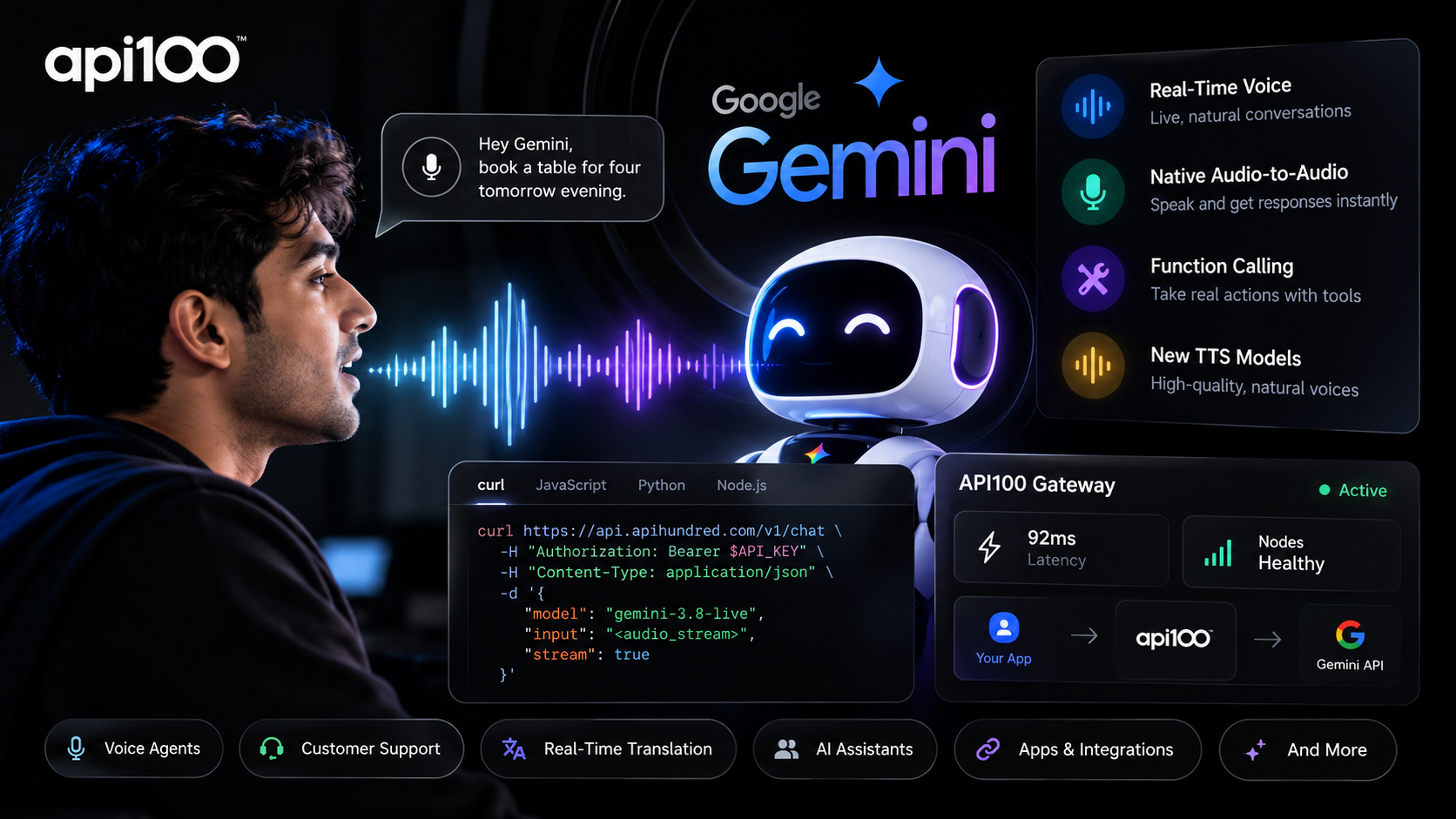
Google’s New Gemini Voice APIs Are Making Real-Time AI Feel More Human
Voice AI is getting a lot more interesting.
For a while, building a voice AI application usually meant connecting several different services together. One service would listen to the user, another would convert speech to text, an AI model would process the request, and another service would turn the response back into speech.
It worked, but it didn’t always feel natural.
There could be noticeable delays between each step, and every additional service meant another API, another bill, and another part of the system that could fail.
Google is now pushing Gemini in a different direction: letting developers work with audio directly in real time.
With the latest Gemini Live API updates, developers can build applications where users can speak naturally with an AI model while the conversation is happening live.
What Is the Gemini Live API?
The Gemini Live API is designed for real-time, bidirectional communication between an application and Gemini.
Instead of sending a request and waiting for a complete response, your application can maintain a live connection with Gemini.
The user speaks.
The application streams the audio to Gemini.
Gemini processes the conversation.
The response is streamed back as audio.
This makes the experience much closer to talking with another person rather than interacting with a traditional chatbot.
For developers, the interesting part isn't just the voice.
It's the architecture behind it.
Real-Time Voice Agents
Gemini's Live API can be used to build more than simple voice chatbots.
With capabilities such as audio streaming and function calling, a voice assistant can potentially interact with the tools and systems behind an application.
For example, imagine saying:
"Book me a table for four tomorrow evening."
A traditional chatbot might explain how to make the reservation.
A properly integrated voice agent could understand the request, call a booking tool, receive the result and tell the user what happened.
That changes the role of voice AI.
It becomes an interface for software.
Why Streaming Matters
Real-time voice applications have very different requirements from normal text-based AI applications.
Latency matters.
If every sentence has to go through multiple services before the user hears a response, the conversation can feel slow and unnatural.
That's why streaming is so important.
The Gemini Live API uses a persistent WebSocket connection, allowing audio and other data to move continuously between the application and the model.
Developers also need to handle things like interruptions.
If the AI is speaking and the user starts talking, the application needs to react quickly instead of allowing the AI to continue talking over the user.
These small details can make a huge difference in how natural a voice assistant feels.
Gemini TTS Is Another Piece of the Puzzle
Google is also expanding its text-to-speech capabilities with newer Gemini TTS models.
This is useful for applications that already have text but need to turn that text into natural-sounding speech.
For example, a developer might use TTS for:
• AI-generated videos
• Audiobooks
• Voice assistants
• Educational applications
• Customer support
• Accessibility tools
• Games and interactive characters
This creates an important distinction.
If an application needs a live conversation, a real-time audio model makes sense.
If an application already has text and simply needs high-quality speech, a dedicated TTS model may be more appropriate.
Developers can choose the architecture based on what their application actually needs.
What Can Developers Build?
The possibilities go far beyond a basic voice chatbot.
Developers can use these technologies to create:
• AI customer support agents
• Virtual receptionists
• Voice-based coding assistants
• Interactive learning applications
• Real-time translation tools
• Gaming characters
• Appointment assistants
• Sales qualification agents
• Enterprise voice assistants
• Voice interfaces for connected devices
The bigger shift is that voice is becoming an interface rather than simply an output format.
The AI can listen, understand, reason, call tools and respond.
What This Means for AI APIs
This is where things become especially interesting for the wider AI API ecosystem.
Modern applications rarely need only one type of AI.
A product might use one model for text generation, another for image generation, another for embeddings, another for speech, and another provider as a fallback.
Managing all of those providers directly can quickly become complicated.
Developers have to think about API keys, authentication, pricing, rate limits, model availability, usage tracking, latency and provider failures.
This is one reason AI API gateways and model-routing platforms are becoming increasingly important.
Instead of connecting an application directly to multiple providers, developers can use a single API layer that manages the complexity behind the scenes.
A typical architecture can look like:
Application → API Gateway → Model Router → AI Provider
The gateway can then handle authentication, rate limiting, usage tracking, cost controls, logging and provider routing.
Voice Makes API Infrastructure Even More Important
Voice workloads also introduce different infrastructure requirements.
A text request might take a few seconds and return a relatively small response.
A voice application can maintain a continuous real-time connection while constantly sending and receiving audio.
That means developers have to think about latency, connection stability, streaming, usage limits and cost much more carefully.
For businesses building voice agents at scale, these infrastructure decisions can become just as important as choosing the AI model itself.
The Bigger Picture
The latest Gemini voice capabilities aren't simply about making AI voices sound better.
The bigger change is that real-time conversation is becoming something developers can build directly into their applications through APIs.
AI can now become part of the interface itself.
Instead of opening an application, finding a button, typing a request and waiting for a response, users can increasingly just talk.
And when that voice interface is connected to tools and APIs, the AI can move from simply answering questions to actually performing actions.
That's where voice AI becomes much more interesting.
Voice isn't just another output format anymore.
It's becoming another way to interact with software.
Build with API100
Access 100+ AI models through one lightning-fast OpenAI-compatible API with sub-50ms routing overhead and zero markup on cached tokens.